Choosing fabric for a sofa, sectional or favorite chair involves more than finding the right color. The best upholstery balances how it feels, how it wears, how it can be cleaned and how it complements your home.
A beautiful fabric can be wrong for a busy family room, while a practical fabric can be surprisingly luxurious. Understanding the differences helps you choose confidently—whether you are ordering new furniture or reupholstering a piece you already love.
Start with three questions: fiber, construction and performance
Fiber content tells you what a fabric is made from: cotton, linen, wool, polyester or another material.
Construction and texture tell you how the yarns create the surface: velvet, chenille, bouclé, twill, basketweave or jacquard.
Performance describes how the finished fabric behaves, including abrasion resistance, cleanability, color retention and resistance to pilling.
These are not interchangeable categories. A velvet can contain cotton or polyester. A bouclé may contain wool, synthetic fibers or both. A linen-look fabric may contain no linen at all. Always read the fiber-content label rather than relying on a collection name. [1]
Natural Upholstery Materials
Natural fibers originate from plants or animals. Examples shown are illustrative; confirm fiber content from the actual fabric label.
Natural fibers come from plants or animals. Familiar examples include cotton, flax linen, hemp, wool, mohair and silk. Natural does not automatically mean stain-resistant, low-maintenance or environmentally preferable in every respect. The finished fabric and its intended use matter.
Cotton
Comfortable, versatile and available in casual or tailored fabrics.
Before choosing: Absorbency makes spills important; examine weave, cleaning instructions and shrinkage precautions.
Linen
Made from flax; admired for its relaxed texture and understated elegance.
Before choosing: Creasing and a lived-in appearance may be part of its character. Ask about seam stability and approved cleaning.
Hemp
Plant-based fiber often used in textural blends.
Before choosing: Feel, finishing and upholstery suitability vary; do not assume every hemp textile is seating-grade.
Wool
Resilient fiber with warmth and substance; useful in tailored upholstery and blends.
Before choosing: Check the finished fabric’s pilling results and care requirements. Wool does not make a fabric immune to stains.
Mohair
Hair from the Angora goat, often made into luxurious upholstery pile.
Before choosing: A specialty choice; review pile appearance, maintenance and price.
Silk
Lustrous and decorative, with a refined appearance.
Before choosing: Usually a more cautious choice for heavily used seating. Confirm light exposure and cleaning limitations.
This is a selection guide, not a durability ranking: a well-engineered natural-fiber fabric can outperform a poorly constructed synthetic one. Natural-fiber blends may also offer a useful balance of texture and stability. [2, 3]
Synthetic and Manufactured Upholstery Materials
Manufactured materials include different fiber categories. Rayon, modal and lyocell are regenerated cellulosic fibers, rather than synthetic polymers.
Synthetic fibers are manufactured from chemical polymers. Common upholstery examples include polyester, nylon, acrylic and olefin. They can be engineered into many looks, from smooth velvet to a convincing linen texture.
Polyester
Versatile, strong and widely used alone or in blends.
Before choosing: Pilling, texture, cleaning and colorfastness are properties of the finished fabric—not guarantees from the fiber name.
Nylon
Often used in blends where strength is useful.
Before choosing: Evaluate the complete blend and test results rather than the nylon percentage alone.
Acrylic
Used in soft woven upholstery and solution-dyed performance fabrics.
Before choosing: Verify whether the particular fabric is solution-dyed and approved for indoor, outdoor or both uses.
Olefin/polypropylene
Low water absorption can be helpful in performance upholstery.
Before choosing: Oil-based soils, cleaning restrictions, heat exposure and the exact manufacturer’s specifications still matter.
Recycled polyester remains a synthetic fiber. Recycled content is useful information, but it is not a substitute for durability testing or a complete environmental assessment. [2, 4]
A third category: regenerated cellulosic fibers
Viscose/rayon, modal and lyocell are manufactured using plant-derived cellulose. They are neither unprocessed natural fibers like cotton nor the same category as polyester. They can provide softness and attractive drape, often in blends. Check the finished upholstery’s cleaning and moisture instructions carefully. “Bamboo” on a label may describe the source of cellulose rather than a directly extracted bamboo fiber. [4, 5]
Upholstery Textures and Constructions
Weaves and textures influence appearance and feel; they do not determine fiber content.
The following names describe appearance or construction, not a fixed fiber content or guaranteed level of durability.
Plain weave, canvas or duck
Straightforward, often casual and tailored.
What to consider: Evaluate yarn quality and density; a plain weave is not automatically a performance fabric.
Linen-look/slub weave
Relaxed surface with intentional yarn variation.
What to consider: Can be natural, synthetic or blended; check the actual label.
Basketweave
Dimensional woven texture, from fine to chunky.
What to consider: Larger, more open constructions deserve extra scrutiny for snagging and seam stability.
Twill, denim or herringbone
Diagonal or directional weave with a tailored character.
What to consider: Check upholstery-grade specifications and potential dye transfer.
Chenille
Soft, fuzzy yarn creates a plush, welcoming surface.
What to consider: Inspect yarn security, pile changes and cleaning guidance.
Velvet/velour
Pile gives color depth and a changing appearance in light.
What to consider: Directional shading and pressure marks can be normal; performance depends on the specific fabric.
Bouclé
Looped yarn produces a nubby surface.
What to consider: Consider loop size where pets, claws or jewelry may catch.
Microfiber/microsuede
Fine fibers create a smooth or suede-like surface.
What to consider: Neither term guarantees stain-proofing; some surfaces show handprints and directional shading.
Corduroy
Raised ribs create warmth and a distinctly tactile look.
What to consider: Assess pile marking, rib scale and cleaning requirements.
Jacquard, damask, brocade or tapestry
Patterns formed through weaving, sometimes with contrasting textures.
What to consider: Examine any long exposed yarns, upholstery suitability and pattern matching.
Printed fabric
Design applied to the surface rather than created solely by colored yarns.
What to consider: Confirm abrasion and colorfastness; do not assume all prints or all woven patterns perform alike.
Knitted upholstery
Loop-based fabric construction, sometimes with stretch.
What to consider: Must be suitable for the furniture’s shape, backing and upholstery method.
These categories overlap: a jacquard may incorporate chenille, and a performance fabric may be woven to look like linen. [1, 4]
Leather is a hide rather than a woven textile. Vinyl and polyurethane-coated upholstery are separate alternatives with their own performance considerations. For polyurethane, ask about hydrolysis resistance—the coating’s resistance to breakdown associated with moisture and heat—not just abrasion. [6]
What does “performance fabric” actually mean?
Performance is not a fiber. It is a description of features engineered into a finished textile. Those features may include stain resistance, easier cleaning, color retention or moisture management.
Ask which features apply to the specific swatch. Stain-resistant does not mean stain-proof. An indoor performance fabric is not automatically suitable outdoors, and “performance” does not automatically mean bleach-cleanable. Follow that exact fabric’s instructions. [7]
Double rubs: what the number tells you—and what it does not
The Wyzenbeek test evaluates abrasion resistance by rubbing a fabric specimen back and forth under controlled conditions. One back-and-forth movement is a double rub. The reported result measures performance in that test, not the number of times someone can sit on your sofa.
The Association for Contract Textiles publishes the following voluntary benchmarks for woven and knit upholstery:
Intended setting
Wyzenbeek
Martindale
Commercial low-traffic/private spaces
15,000 double rubs
20,000 cycles
Commercial high-traffic/public spaces
30,000 double rubs
40,000 cycles
These are two different tests. There is no reliable conversion between their results. Always check which method was used. The table pairs application benchmarks; it does not equate the measurements. [8]
For busy household seating, meeting a high-traffic abrasion benchmark can be a useful screening consideration, alongside the manufacturer’s residential recommendation. A rarely used accent chair may have different needs.
A 100,000-double-rub fabric is not guaranteed to last twice as long as a 50,000-double-rub fabric. ACT warns that higher results do not establish longer service life. Abrasion also does not tell you whether a fabric resists stains, claws, fading or poor cleaning. [8, 9]
Durability is more than rubbing resistance
Before selecting upholstery, examine these separate concerns:
Pilling: whether loose fibers form small surface balls.
Seam slippage and strength: whether yarns separate or the textile fails around stressed seams.
Snagging: whether exposed loops or yarns catch.
Colorfastness: resistance to fading and transfer of color through rubbing.
Appearance retention: whether the surface crushes, stretches or changes noticeably.
Cleanability: whether the approved method fits your household’s needs.
Read the cleaning code, too. W generally indicates water-based spot cleaning; S indicates solvent-based spot cleaning; W/S permits either approved approach; X generally means vacuuming or brushing only. The manufacturer’s specific instructions take precedence. A removable cushion cover is not necessarily machine washable.
For pets, a tighter surface with fewer exposed loops is worth considering, but no upholstery is claw-proof. For sunlight, look for documented lightfastness and manage exposure. For children and frequent entertaining, easy approved cleaning may matter more than an exceptionally high abrasion number.
Which upholstery fabrics are most popular?
There is no universal, verified sales ranking that compares fiber names, textures and performance categories on equal terms. Preferences vary by price, region, household and design style.
The following is an editorial shopping guide, ordered from broad everyday appeal to more specialized appeal. It is not national sales data, a claim about our showroom’s sales, or a quality ranking. Adjacent positions are not measurable differences in popularity.
1. Easy-care performance woven fabrics, including linen-look blends
Combines a versatile appearance with practical maintenance features.
2. Soft textured weaves and chenille
Offers inviting comfort without necessarily looking formal.
3. Linen and cotton blends
Appeals to buyers wanting relaxed or tailored natural character.
4. Upholstery velvet, including tested performance options
Chosen for rich color, softness and a more expressive room.
5. Bouclé and nubby textures
Adds sculptural texture; loop construction requires household-specific consideration.
6. Microfiber and microsuede
Appeals to buyers prioritizing a smooth, soft surface and practical styling.
7. Wool and wool blends
Suits tailored, material-focused interiors and buyers seeking natural resilience.
8. Stripes, checks, jacquards and other patterned upholstery
More design-specific; can define a chair or an entire room.
9. Corduroy and strongly ribbed textures
Distinctive tactile and retro character makes it a more selective choice.
10. Specialty luxury textiles such as mohair and silk-rich fabrics
More specialized because of price, styling and care requirements—not necessarily lower quality.
For a truly measured most-to-least-popular list, use a defined sample of actual sales, with consistent categories and a stated date range.
Upholstery design trends in 2026
Recent furniture-market coverage points toward expressive rooms: layered textures, richer color and familiar patterns used in fresh ways. Spring 2026 High Point reporting highlighted greens, renewed interest in lighter blues and tapestry-inspired upholstery; another market report noted tailored plaid and suiting-style fabrics. These are observations from market introductions, not proof of national sales leadership. [10, 11]
Here are ways to interpret those directions without making your furniture feel temporary:
Build with texture, not just color. A softly textured sofa, smoother accent chair and patterned cushion can create depth within a restrained palette.
Use warmer neutrals as a flexible foundation. Oatmeal, mushroom, taupe and brown are useful styling options—not a requirement to replace cooler colors you enjoy.
Let an accent piece carry the stronger personality. Olive, blue, rust or burgundy upholstery can add interest without committing every large piece to the same color.
Consider a tailored pattern. A small check, stripe or subtle herringbone can complement contemporary furniture as well as traditional designs. Pattern scale and placement matter.
Treat bouclé as an option, not an obligation. Its texture can be beautiful, but it should fit your maintenance expectations and household rather than simply follow a trend.
Choose lasting needs first. Comfort, appropriate performance, cleanability and a color you enjoy are durable priorities. A fashionable texture is best when it also meets those needs.
Bring the swatch home before deciding
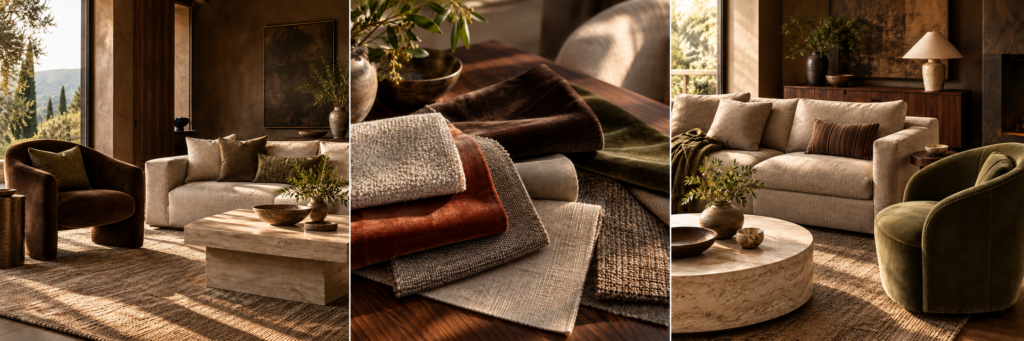
View samples in daylight and evening light. Compare them with flooring, wood finishes, rugs and any leather furniture already in the room. Feel the fabric against your skin and consider its texture on a full sofa, not just a small sample.
Then confirm the exact fiber blend, abrasion test method, cleaning instructions, suitability for the chosen furniture and warranty limitations.
At Leather Leather Furniture Gallery in Menlo Park, we can help you explore upholstery options for new custom furniture and reupholstery. Our goal is to find a fabric that suits both the look you love and the way you live.


Comments are closed here.