A sofa may be the largest piece in a living room, but the rug often gives the room its direction. It connects the seating, establishes a palette, and brings softness and texture to the space. In an open floor plan, it can define a conversation area without adding a single wall.
At Leather Leather Furniture Gallery in Menlo Park, we consider the rug alongside the furniture. A chestnut leather sofa can take on a completely different character over a quiet ivory weave, a richly patterned traditional rug, or an expressive contemporary design. Choosing the rug early makes it easier to coordinate leather, fabric, pillows, and other finishes.
We have worked with Surya, Jaipur Living, and Loloi as a dealer. Understanding how rugs are made—and how they will live in your home—helps narrow the choices beyond color alone.
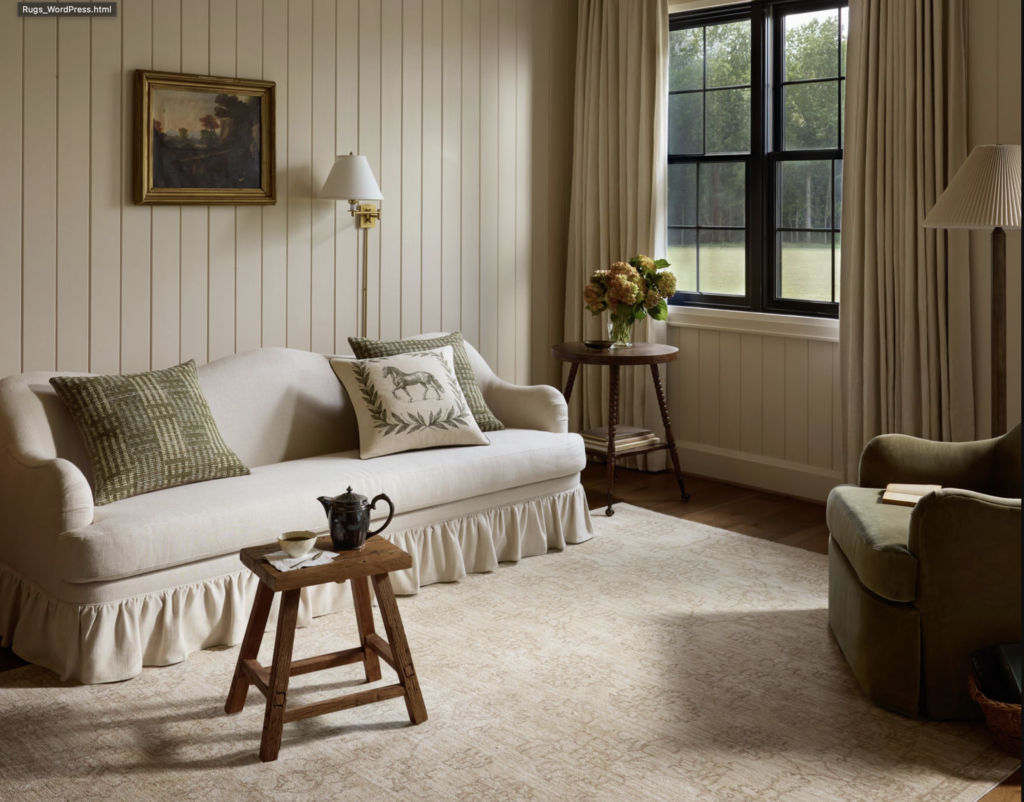
Photo: Chris Loves Julia × Loloi. Miriam MIR-04 Ivory / Neutral.
Where Rugs Come From: A Tradition Across Cultures
Rug weaving has a long history across Central Asia and the Middle East. Its exact beginnings cannot be assigned neatly to one country. Over centuries, practical textiles also became objects of artistic expression, trade, and prestige. Persian, Ottoman, and Mughal workshops helped develop elaborate carpet traditions in what are now Iran, Turkey, and India.
Iran, historically Persia, is associated with sophisticated floral compositions, medallions, and regional weaving traditions. Turkey has an equally important heritage of pile carpets and flatwoven kilims, including the celebrated Ushak—or Oushak—tradition. India developed major carpet workshops under the Mughals and remains a source of both traditional and contemporary rugs.
Nepal is another source of fine contemporary hand-knotted rugs, including wool and silk designs. Morocco has diverse weaving traditions, from urban carpets to textiles made in rural communities; its heritage is much broader than the ivory-and-diamond look often described as Moroccan inspired.
A design name does not necessarily identify where a rug was made. A Persian-inspired pattern may be produced elsewhere. Read the country-of-origin label and evaluate the actual fiber, construction, and finishing rather than treating a geographic name as a quality guarantee.
How Construction Changes a Rug
Hand knotted: Individual knots are tied onto a foundation. The process requires considerable skill and time, helping explain the price of many fine rugs. Design complexity, yarn quality, and workmanship matter alongside knot count.
Hand tufted: Yarn is inserted through fabric with a tufting tool and secured with backing. This can create a plush, beautifully detailed rug with less labor than hand knotting. “Handmade” therefore does not automatically mean “hand knotted.”
Hand loomed or handwoven: A weaver works on a hand-operated loom. These categories include varied textures and constructions; check the specific product rather than assuming all handwoven rugs are alike.
Flatweave: Warp and weft create a flat textile without a raised pile. Kilims and dhurries are familiar examples. Some are reversible; confirm the individual design.
Power loomed: Machinery produces the rug, allowing repeatable patterns and generally more accessible pricing. A machine-made rug can be an appropriate choice for a busy home.
Pile describes the surface rather than the weaving method. Cut pile, loop pile, shag, and high-low textures each feel different. Consider door clearance, chair movement, and vacuuming as well as appearance.
Rug Materials: What Is Underfoot?
Wool offers softness and resilience and is a versatile choice for living spaces. Shedding can occur, particularly in new rugs. It is not stain proof, and prompt spill care still matters.
Silk brings a fine texture and natural sheen. It can add beautiful detail to a rug, but requires thoughtful placement and specialist care.
Viscose and other regenerated cellulose fibers can create a luminous surface. Viscose is not the same as natural silk and can be sensitive to moisture and wear. Marketing terms such as “bamboo silk” deserve a closer look at the actual fiber label.
Cotton is common in casual weaves and rug foundations. Jute, sisal, and seagrass introduce plant-fiber texture, but differ in feel and care requirements. Do not assume a natural-fiber rug is suitable for damp locations.
Polyester and polypropylene are common synthetic choices. Their practical appeal depends on construction, backing, and the manufacturer’s care instructions. “Synthetic” does not automatically mean outdoor safe or machine washable.
Blends combine characteristics: a wool rug with silk accents will behave differently from one containing viscose. Ask for the fiber percentages, not simply a description such as “silky.”
Why Does One Rug Cost More Than Another?
Two rugs can look similar in a photograph and still be very different purchases. Price can reflect the labor needed to make the rug, the quality and quantity of its fibers, the complexity of the design, and the care taken in dyeing and finishing.
A densely detailed hand-knotted piece may require far more work than a simpler design. Premium fibers, hand processing, unusual dimensions, custom colors, and limited production can also add cost. For antique rugs, condition, rarity, provenance, and collectibility introduce another set of considerations.
Compare the same approximate size: a 9-by-12-foot rug has 108 square feet, while an 8-by-10 has 80—35 percent more surface area. A larger size can therefore make a substantial difference even within the same collection.
Higher knot count can support finer detail, but it is not a universal score for quality. A beautifully made, coarser weave may be exactly right for the design. Thickness and sheen are not reliable price or durability tests either.
The useful question is: What am I paying for, and does it suit this room? Ask about construction, fiber content, backing, expected shedding, cleaning, and repair options. A higher price does not make a delicate rug the best choice for every household.
Finding Your Rug Style
Traditional: Medallions, floral patterns, and borders can bring richness to classic interiors or provide an engaging contrast with modern furniture.
Transitional: Familiar motifs in quieter colors or simplified arrangements bridge traditional and contemporary furnishings.
Contemporary and abstract: Gestural patterns, irregular shapes, or tonal movement can make the floor feel like a piece of art.
Geometric and tribal inspired: Repeated lines, diamonds, and rhythmic motifs add structure. Descriptions such as “Moroccan inspired” describe a look; they do not establish origin.
Textural and tonal: A restrained palette lets the weave, pile, and subtle color variation take the lead. This can be particularly effective beside distinctive leather upholstery.
Vintage and vintage inspired: An actual older rug and a newly manufactured distressed design are different products. Both can create a layered look, but ask which you are considering.
Coordinate rather than match every color. Pull one supporting shade from the rug into a pillow or chair, and vary the scale of patterns. View a sample in your room: daylight, evening lighting, and pile direction can change how color reads.
Rug Placement: Connect the Furniture
Living rooms: Use the seating group as your guide. Having the front legs of the sofa and main chairs on the rug is a useful starting arrangement. In a larger room, placing the entire group on the rug can create a generous, unified area. Center the rug on the conversation group rather than automatically centering it in the room.
Sectionals: Measure the full arrangement, including the chaise. Aim for a rug that connects the main sections and nearby chairs instead of leaving the chaise visually stranded. Tape out the footprint before ordering.
Dining rooms: Start with approximately 24 inches of rug beyond every table edge, then test your actual chairs pulled out. More clearance may be needed. Include table leaves if you regularly use them. A lower, smoother surface usually makes chair movement easier.
Bedrooms: Plan for comfortable rug exposure where you step out of bed. An 8-by-10-foot rug is a common starting point for a queen; a 9-by-12 can suit many king arrangements. Larger rooms or placing nightstands on the rug may require more. These are starting points, not guaranteed fits.
Entryways and runners: Check the door swing and the combined thickness of the rug and pad. Keep edges out of awkward turning points and make sure the rug lies securely.
How to Measure Before You Buy
1. Measure the room and sketch doors, hearths, built-ins, and main walkways. Note any clearance restrictions.
2. Measure the furniture arrangement in its intended position. Include the chaise, chairs, bed frame, or extended dining table—not just the largest furniture piece.
3. Mark the proposed rug outline with floor-safe painter’s tape. Try nearby sizes so you can see how each changes the room.
4. Test daily use. Pull out dining chairs, walk around the bed, open doors, and check the path around the sofa.
5. Confirm the actual listed dimensions before ordering. A nominal size category may differ from the finished measurements, and handmade pieces can vary. Ask whether fringe is included.
For example, a dining table measuring 42 by 84 inches, plus 24 inches on each side, calls for a minimum footprint of 90 by 132 inches—7 feet 6 inches by 11 feet. A true 8-by-12-foot rug would meet that starting footprint; an 8-by-10 would be too short. Larger chairs may need more room.
Choose a pad appropriate for the rug and your flooring finish. Follow the rug and flooring manufacturers’ guidance, and size the pad so it stays concealed beneath the rug.
Bring the Room Together
A well-chosen rug gives furniture a place to belong. Its scale can make the seating feel more connected, its texture can balance leather and wood, and its colors can guide the rest of the room.
Visit Leather Leather Furniture Gallery in Menlo Park to discuss rug options from Surya, Jaipur Living, and Loloi alongside your furniture and upholstery selections. Bring room measurements, photographs, and any leather or fabric samples you are working with so we can consider the room as a whole.
Comments are closed here.