
High Point Market Through My Eyes
An interior designer’s perspective on where home design has been—and what I’m looking for next
By Tricia Mulcahy · Owner, Leather Leather Furniture Gallery · Interior Designer Fall High Point Market · October 17–21, 2026
.
Every spring and fall, I travel to High Point Market with a question in mind: what is worth bringing home—not simply because it is new, but because it could make a home more comfortable, more personal, or more thoughtfully designed?
As the owner of Leather Leather Furniture Gallery in Menlo Park and as an interior designer, I look at Market through both a practical and a creative lens. I want to understand the construction, materials, comfort, and options behind a piece. I also want to see what it contributes to the room around it.
My interest extends well beyond upholstery. Lighting, rugs, dining furniture, cabinets, coffee tables, artwork, mirrors, and decorative objects all influence the way we experience a home. I believe the strongest interiors come from considering those relationships together.
This is my starting point for Fall Market: a look at the design directions I find meaningful, the habits I think are worth reconsidering, and the announced introductions I want to examine more closely. As I visit the showrooms, I’ll add my own photographs and impressions.
I Believe a Home Should Feel Collected, Not Prescribed
I do not believe a well-designed home needs to look as though everything arrived on the same day. A favorite older piece can belong beside something contemporary. A familiar wood finish can work with a new material. A room can have cohesion without every element matching.
That is also how I approach trends. I see them as a source of possibilities, not a list of instructions. A beautiful introduction should still pass the questions I would ask of any piece: does it fit, does it function, does it feel right, and will the person living with it continue to enjoy it?
I am less interested in declaring a style “over” than in finding ways to help a room evolve. The best change may be a new sofa, but it could just as easily be a larger rug, better lighting, a different table, or renewed upholstery on a piece someone already loves.
Looking Back: Moving Beyond a Single Neutral

A console, circular mirror, and layered finishes illustrate how different elements can form a coordinated composition. Reference image; not a confirmed showroom offering. Image: Sarreid / ANDMORE Market Snapshot.
Cool grays, crisp white surfaces, and tightly coordinated finishes have offered one language for contemporary interiors. I do not think those choices automatically make a home dated. What matters is how they are balanced.
My preference is to give a neutral room some depth. That might mean introducing tobacco or cognac leather, a warmer wood tone, a muted green, or a textile with visible variation. I like a palette that has several related notes rather than one color repeated everywhere.
Nor do I think moving toward warmth requires turning every room beige. A blue-gray rug can look beautiful with warm wood. Dark metal can give a softer palette definition. The relationships matter more to me than whether an individual finish is currently fashionable.
At High Point, I will be watching how new wood finishes, metals, and colors work together in person. A finish that looks rich on a screen may feel entirely different under showroom light.
My Approach to Curves: Contrast Before Repetition
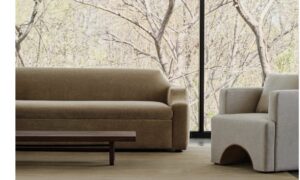
American Leather A.L. Studio collection imagery provides a reference for balancing soft seating shapes with other room elements. Not my firsthand Market photograph. Image: American Leather A.L. Studio.
I appreciate a curved form when it solves something in the room. A rounded table can ease movement around a seating area. A softer chair profile can provide a useful contrast to a more architectural sofa. A sculptural base can give a quiet room a point of interest.
But I do not think every piece needs to curve. Too much repetition can make a room feel as coordinated as a matching set, even when the shapes are fashionable.
My own approach is to balance structure with softness. I want to see a strong overall silhouette, but I also want practical proportions, comfortable reach, and enough clearance to move naturally.
ANDMORE’s Fall preview includes “Unearthed,” a direction concerned with organic forms and earthy materials. I see that as an invitation to examine surfaces and shapes closely—not a reason to assume every stone-like finish is natural stone or every irregular surface is handmade.
Traditional Details Can Bring Personality to a Modern Room

A decorative mirror offers a reference for bringing an older-looking detail into a more restrained composition. Cooper Classics image; this is not the Quorum Dorato collection. Image: Cooper Classics / ANDMORE Market Snapshot.
I like the tension between something clean-lined and something with a little history in its expression. A decorative mirror, an aged finish, or a carefully chosen cabinet can add depth to a contemporary room.
That does not require creating a period interior. In my view, the surrounding space is what allows an expressive piece to feel intentional. An ornate mirror may need a quieter console beneath it; a richly finished cabinet may benefit from simpler objects above it.
The “New Heirlooms” direction in ANDMORE’s preview gives a name to that interest in familiar details and a collected atmosphere. My own priority is finding pieces that can live comfortably with what a customer already owns.
Artwork and wall hangings deserve the same thought. I consider their scale, placement, color, and relationship to the furniture before treating them as a way to fill an empty wall.
I Treat Lighting as Part of the Room Plan

Sculptural lighting can contribute shape and atmosphere as well as illumination. Hubbardton Forge reference image; not a Sonneman, Corbett, or Mitzi product. Image: Hubbardton Forge / ANDMORE Market Snapshot.
I believe lighting should be considered early, not saved until the furniture has been selected. It affects how we see color and texture, where a room feels inviting, and whether the space works for reading, conversation, or quieter evening use.
A fixture also has a physical presence. I look at shade material, the direction of light, the relationship to nearby furniture, and what the piece looks like when it is switched off.
Official Fall previews describe Sonneman’s interest in natural materials and softer geometry, Corbett’s vintage and Art Nouveau references, and Kate Marker’s first Mitzi Tastemaker collection. These are different approaches, but each gives me something specific to evaluate.
What I want to bring back is an explanation of why a fixture works—not simply a photograph of a striking chandelier. I will be looking at both the impression it creates and the practical questions a homeowner should ask.
I Start a Rug Conversation with Size and Texture

A Lavin rug from the official Fall preview illustrates a muted geometric color story. This image is not Nourison Moonstone; collections are identified separately in the text. Image: Lavin / ANDMORE Market Snapshot.
A rug is one of the most important tools for connecting a seating arrangement. I consider its dimensions alongside the furniture layout, rather than selecting a pattern first and hoping the available size will work.
I also think texture deserves more attention. A rug can make a quiet palette feel interesting without requiring a bold pattern. A more expressive design can become the starting point for the rest of the room.
Nourison’s Fall preview includes the Moonstone collection, described through tonal color and dimensional texture, as well as custom-size rug capabilities. I am interested in how those options might support rooms that do not fit standard layouts.
In person, I want to examine the pile, edges, materials, and color changes under light. I also want to know what care the rug needs and whether its construction suits the intended use. A showroom photograph cannot answer those questions.
Case Goods Need to Work as Well as They Look
A dining table, sideboard, bookcase, or console gives a room structure. I believe those pieces should be evaluated with the same attention we give to upholstered seating.
I look at the usable surface, storage arrangement, drawer and door operation, base placement, and how the dimensions relate to the room. A dramatic table base still has to leave comfortable space for the people sitting around it.
This fall’s “Refined Retro” preview direction references richer woods, rounded forms, brass, and autumnal color. I am interested in seeing those ideas interpreted in occasional and storage furniture, while keeping function at the center of the conversation.
My goal is to find pieces that contribute to the room without making everyday life more complicated.
I Prefer Accessories with Presence and Breathing Room

Sculptural objects offer a reference for shape, contrast, and restrained styling. Accent Decor image from the Fall preview; availability through our showroom is not implied. Image: Accent Decor / ANDMORE Market Snapshot.
I do not think every surface needs to be filled. A few well-chosen objects can be more effective than a crowded arrangement that hides the furniture beneath it.
I like to consider height, shape, texture, and negative space. A vessel may need nothing inside it. A tray can create order. One larger object can sometimes do more for a room than several small ones.
The same restraint applies to mirrors and decorative hardware. Quorum’s announced Dorato LED mirrors and Modern Matter’s collaboration with Schumacher are examples of introductions worth investigating. I want to see how their detailing feels in person before deciding where I would use it.
For me, these smaller elements are an opportunity to make a home personal—not simply an opportunity to add more.
On My List: American Leather’s A.L. Studio

Official A.L. Studio chaise imagery from American Leather. This is collection photography, not my photograph from High Point. Image: American Leather A.L. Studio.
When it comes to upholstery, I will be focusing on the lines we carry at Leather Leather Furniture Gallery. One announcement I am particularly interested in exploring is American Leather’s A.L. Studio.
American Leather describes this new collection as a more design-forward offering, with expressive silhouettes and American craftsmanship. Its official page identifies an October 2026 High Point launch and national availability in early 2027.
What interests me as a designer is how a statement piece can become part of a livable room. I want to experience the scale, sit in the designs, examine the upholstery details, and understand how the available choices affect the result.
I will share those impressions after seeing the collection. This is a preview of what I am going to evaluate, not a claim that the pieces are already on our floor or ready for immediate delivery.
Why I Keep Going Back Every Spring and Fall
I can learn a great deal from catalogues and photographs, but there is no substitute for experiencing the furniture and materials directly. I want to understand the scale of a cabinet, the feel of a textile, the way a finish catches light, and how a seat supports the body.
Speaking with the companies is equally valuable. It is an opportunity to ask what can be customized, what has changed, and what information will help our customers make a good decision.
I travel to High Point to develop my judgment, not simply to collect images. I want to come back with ideas I can explain and selections I can stand behind.
Bringing the Ideas Home
I believe a home should evolve around the people who live in it. New introductions can open possibilities, but they should not make someone feel that everything they own suddenly needs replacing.
A favorite piece may remain the starting point. Appropriate reupholstery, restoration, or cushion replacement may help it continue to work. A new rug, better lighting, or a different furniture arrangement may be enough to bring the room into focus.
During Market, I will share discoveries across the whole home: what caught my attention, why I think it matters, and where I would consider using it. I will distinguish announced products from pieces I have seen firsthand and offerings confirmed through our showroom.
That is the perspective I want to bring home from High Point: design that is thoughtful, comfortable, and individual—rather than a room built around a trend for its own sake.
Tricia Mulcahy Owner, Leather Leather Furniture Gallery | Interior Designer 935 El Camino Real, Menlo Park, California
Contact our showroom to discuss your home.
Preview Sources and Photo Credits
Preview information reviewed October 17, 2026. Design opinions are my editorial perspective. Product announcements and availability are attributed to the companies and may change. Outside accessory and case-goods references do not establish that we carry those products. All upholstery pictured is American Leather.
High Point Market Authority — dates and Market reference photography (https://www.highpointmarket.org/) ANDMORE — Fall 2026 Market Snapshot themes and credited product images (https://www.andmorehighpointmarket.com/market-snapshot) High Point Market — Fall lighting announcements (https://www.highpointmarket.org/ProductShowroomNews) Nourison — Fall rug preview and custom-size capabilities (https://www.nourison.com/high-point-fall-market-2026) High Point MediaLink — mirror and decorative hardware announcements (https://medialink.highpointmarket.org/news/exhibitor) American Leather — A.L. Studio introduction, imagery, and availability (https://www.americanleather.com/studio/)
Reference images are supplied by the credited companies or Market organizers; rights remain with their owners. They are not my firsthand photographs from this trip.
Comments are closed here.