Whether upholstered in leather or fabric, a beautifully made sofa should feel as good as it looks—and make sense for the way you live. American-made upholstery often brings exceptional customization, a deep tradition of craftsmanship, and a shorter journey from factory to home. European collections introduce another rich perspective, from expressive Italian silhouettes to the quiet precision of Scandinavian design.
At Leather Leather Furniture Gallery in Menlo Park, we carry both because each brings something valuable to a room. Some customers fall in love with the reassuring comfort of a traditionally tailored American sofa. Others want a sculptural sectional that changes the character of the entire space. And increasingly, they discover that excellent craftsmanship and contemporary design can come together in the same piece.
The most useful comparison goes beyond a country label. It considers the actual factory, construction, proportions, materials, customization, and delivery plan behind the furniture you are choosing.
The Difference at a Glance
| What matters |
American-made upholstery |
European-made upholstery |
| Design |
Traditional, transitional, and contemporary options; many strong custom programs. |
Italian collections often emphasize sculptural form; northern European collections frequently favor visual simplicity and function. |
| Craftsmanship |
Hand tailoring, frame building, spring work, and upholstery traditions, often combined with modern equipment. |
Leather tailoring, precise sewing, and upholstery expertise, also often combined with modern production. |
| Comfort |
Broad choices in cushions and proportions, depending on the brand and program. |
Broad choices, including low lounge seating and engineered recliners; the model matters more than geography. |
| Customization |
Can extend to dimensions, cushion choices, trim, and configuration on selected programs. |
Often extensive covering and modular options; dimensional changes depend on the factory. |
| Delivery |
In our showroom experience, domestic special orders are generally quicker to obtain than comparable overseas special orders. |
Overseas special orders usually require additional transport planning; U.S. stock can change that comparison. |
| Best starting point |
Personalized comfort, custom details, domestic manufacturing, or a tighter timeline. |
A distinctive silhouette, particular European design language, or a specific comfort mechanism. |
These are shopping tendencies, not rules or measured rankings. Availability and construction vary by collection.
Start Inside: The Construction That Supports Leather and Fabric
Leather and fabric change a sofa’s appearance and feel, but both depend on the same foundation: a well-designed frame, a suitable suspension system, resilient cushions, and careful upholstery work. A beautiful covering cannot compensate for poor construction underneath it.
1. Frames, Joinery & Reinforcement
The frame gives a sofa its shape and supports the stresses of everyday use. Ask about the material, how the joints connect, and where the structure is reinforced. “Hardwood” alone is not a complete specification: the design, material quality, joints, and assembly all deserve attention.
Kiln-drying controls moisture in wood before construction; it does not guarantee the quality of every finished frame. Furniture-grade engineered wood can also be part of a thoughtfully designed structure. Look for an explanation of how rails, arms, backs, and load-bearing joints work together, rather than judging a piece by one material name.
Corner blocks help reinforce stressed joints. Glue, screws, dowels, and other fasteners serve different purposes; good workmanship means using the appropriate combination for the design. American Leather’s Alessandro sofa, for example, specifies an all-hardwood frame and corner-block construction. That is a model-specific detail, not a specification to assume across every product. [18]
2. Suspension: What Sits Beneath the Cushion?
Suspension supports the cushion and helps determine how the seat responds under you. Four approaches are useful to understand:
| System |
How it works |
What to compare |
| Eight-way hand-tied coil springs |
Coil springs are tied in multiple directions to help control their movement as a coordinated seat foundation. |
Spring placement, the supporting base, tie quality, frame anchoring, and the finished seat feel. |
| Sinuous or serpentine springs |
Shaped steel springs span the seat frame and flex under load. |
Spring specification, spacing, attachment quality, bracing, and how the system works with the cushions. |
| Elastic webbing |
Tensioned straps form a flexible support surface beneath the upholstery. |
Webbing specification, arrangement, tension, anchoring, and suitability for the intended design. |
| Engineered platforms or motion structures |
A purpose-designed support assembly works with a particular seat, sleeper, or reclining mechanism. |
The complete assembly, support through movement, service access, and applicable warranty terms. |
Eight-way hand tying is a labor-intensive craft associated with fine traditional upholstery. It deserves recognition, but it is not the only route to a well-built sofa. A lower-profile European design may use a different system to achieve its proportions and feel.
For a concrete comparison, Carolina Custom Leather publishes eight-way hand-tied construction, Omnia describes tempered-steel spring suspension, and Gamma’s SUNSET ROUND specification identifies reinforced elastic webbing. These examples show why we should compare the system actually used in a selected model instead of assuming that every American or European sofa shares one construction method. [3] [4] [19]
3. Cushion Construction: Density, Firmness & the Layers Around the Core
Foam density and firmness describe different things. Density measures mass relative to volume; firmness describes resistance to compression. A firmer cushion is not automatically a higher-density cushion, and a softer seat is not automatically lower quality.
Ask what is inside the cushion: a foam core, a spring unit, fiber, feathers or down, or a layered combination. High-resilience foam, spring-down cushions, and down-wrapped cores can create different experiences. Compare support, recovery after use, edge feel, and the amount of routine fluffing or reshaping you prefer.
Also distinguish loose cushions from tight upholstery. Removable cushions may offer convenient maintenance options, but the cover’s cleaning instructions still apply. A zipper does not mean a cover can be machine-washed.
4. Craftsmanship You Can See
Careful cutting, sewing, and fitting matter in both leather and fabric. Examine whether piping follows the shape evenly, seams remain straight, cushion corners look balanced, and the upholstery sits neatly around arms and bases. Check the back and sides as well as the front.
On patterned fabric, ask how stripes, checks, or larger motifs will align across cushions and adjacent sections. On velvet or other directional textiles, consistent nap direction affects the way light plays across the piece. These details take planning before the first seam is sewn.
Leather requires a different cutting judgment: the maker must consider hide size, natural markings, panel placement, and the character of the chosen leather. Extra seams can be intentional design details or practical responses to the covering; fewer seams are not automatically better.
Hand-applied trim, decorative stitching, carefully fitted curves, and well-finished exposed wood are additional expressions of craft. A skilled upholsterer’s work can be visible in a traditional skirted sofa or a sculptural contemporary chair.
American Upholstery: Craftsmanship with Room to Make It Your Own
One of the strongest reasons to explore American-made upholstery is the connection between the customer and the workroom. Selected factories can build around your preferred leather, fabric, cushion feel, configuration, or decorative details rather than limiting you to a few finished combinations.
“Old-school craftsmanship” describes skills that still matter: cutting a cover carefully, matching seams, building and reinforcing a frame, applying trim, and shaping an upholstered piece so that it looks balanced from every angle. Those skills remain relevant whether the final sofa has rolled arms and nailhead trim or a clean, contemporary profile.
Carolina Custom Leather describes solid-hardwood frames, eight-way hand-tied construction, and a spring-down standard cushion. Sherrill describes combining traditional hand craftsmanship, including eight-way hand-tied springs, with modern manufacturing. Omnia highlights in-house cutting, sewing, framing, and individual bench production. These are specific approaches worth comparing—not evidence that every American sofa is built the same way. [3] [4] [5]

Inside an Omnia chair: a manufacturer illustration of frame reinforcement, spring support, cushioning, and upholstery. Construction varies by model.
Photo / illustration source.
Why Domestic Orders Can Arrive Sooner
For many of our customers, timing is a practical advantage of domestic manufacturing. A piece built in the United States does not need an overseas ocean crossing before entering the domestic delivery network. Omnia’s California location is especially relevant to our California showroom.
That shorter route can simplify the overall journey, but production capacity and material availability still matter. A custom order with an unavailable leather can take longer than an imported piece already in a U.S. warehouse. A factory shipping estimate also differs from the date furniture reaches your home: freight, receiving, inspection, and local delivery scheduling must be considered.
We compare the current estimate for your actual order rather than attaching a universal number of weeks to an entire country.
European Upholstery: Design That Shapes the Room
European upholstery offers more than one aesthetic. Italian furniture can bring expressive curves, architectural proportions, distinctive bases, and carefully considered leather seams. Scandinavian-inspired collections often create a lighter impression through restrained shapes and visible legs. German comfort seating introduces another perspective, with function and adjustability woven into the design.
These are aesthetic observations across selected collections, rather than a claim that all European furniture looks alike. A pared-back sofa can feel timeless; a dramatic sectional can become the room’s focal point. Neither needs to compromise the quality of the upholstery work underneath.
Gamma is an especially useful example. The company describes keeping its production in Forlì, Italy, and pairing leather-working expertise with contemporary forms. Its emphasis on handwork challenges the assumption that American furniture represents craftsmanship while European furniture represents design. The best examples offer both. [6]
Italian Expression and Northern European Restraint
If you want your seating to make an architectural statement, begin by comparing Gamma and the relevant Natuzzi collection. Look at the relationship between the arm, back, base, and surrounding floor space—not simply the upholstery color.
If you prefer a quieter room, Vilmers offers a different direction. Its FJORD sofa, for example, pairs defined arm and back lines with a light leg structure. This is an appealing reminder that European design can be understated as well as dramatic. Vilmers traces its manufacturing story to Lithuania and describes its furniture as made to order. [7] [8]

Vilmers FJORD in fabric: defined tailoring and a light-looking base give a different expression to contemporary upholstery.
Photo / illustration source.
American Leather: Where Domestic Craftsmanship Meets Modern Design
American Leather is one of the clearest examples of why this comparison should leave room for overlap. The company manufactures its made-to-order furniture in Dallas, Texas, and presents design, craftsmanship, and innovation as connected priorities.
Its collections include the Comfort Sleeper, motion furniture, and accent seating. For a customer who wants a contemporary room with useful everyday function, that makes American Leather an important starting point. You can explore a domestic option without assuming you must choose a traditional silhouette.
The company’s engineering background also shows why modern production and hand craftsmanship can work together. Precision and efficiency do not eliminate the need for skilled people to cut, sew, upholster, and finish furniture well. [1] [2]

American Leather’s Lisben imagery shows leather upholstery and reclining function within a clean contemporary design.
Photo / illustration source.
Omnia offers another connection between the two traditions: Italian family roots, European leather sourcing, and manufacturing in Chino, California. Black Label Home is also worth exploring when a project calls for a tailored contemporary look and custom work. “Made in America” describes where a piece is manufactured; it does not prescribe a single design style. [3] [15]
The Brands We Carry—and What Each Brings to the Comparison
American Leather
Dallas craftsmanship and modern function. A strong place to begin for contemporary upholstery, sleeper seating, and motion designs. It helps connect the appeal of domestic manufacturing with a modern interior. [1]
Bradington-Young
American leather upholstery with stationary and motion choices. Its North Carolina manufacturing heritage and leather seating focus make it a useful comparison for customers who want tailored comfort. Compare the construction and options of the particular stationary or motion piece you are considering. [9]
Omnia Leather
California manufacturing with Italian roots. Omnia’s Chino factory and broad covering and comfort choices make it especially relevant for customers seeking personalized domestic upholstery. Its history connects European leather traditions with American manufacturing. [3]
Carolina Custom Leather
Traditional construction and custom possibilities. Its published frame, spring, and cushion specifications provide a concrete starting point for discussing what is beneath the leather. Ask which changes are available for your chosen design. [4]
McKinley Leather
North Carolina upholstery and individualized character. McKinley is worth exploring for customers who want to compare leather, finish, scale, and custom seating possibilities. Confirm the current program and shipment estimate for your selected piece. [10]
Sherrill Furniture
American hand craftsmanship and custom upholstery. Sherrill is a natural starting point for customers drawn to traditional or transitional rooms, with covering and tailoring choices that personalize the result. Its construction story combines established upholstery techniques with modern manufacturing. [5]
Black Label Home
Custom work and contemporary possibilities. Black Label Home offers another way to explore furniture built around a room’s particular design needs. Its Southern California manufacturing partnership with Vioski provides a useful example of domestic production serving contemporary design. [15]
Gamma
Italian manufacture and expressive leather tailoring. Gamma is a strong comparison for customers seeking a contemporary statement piece with carefully considered detail. Its Forlì production and emphasis on skilled handwork connect visual innovation with craft. [6]
Natuzzi
Italian design with collection-specific manufacturing. Natuzzi Italia and Natuzzi Editions should be distinguished when discussing origin. Natuzzi promotes Italia through its Made in Italy design identity, while its wider manufacturing network spans several countries. We confirm the collection and origin of the actual item rather than treating the entire brand as one manufacturing location. [11]
Vilmers
Lithuanian manufacturing heritage and Scandinavian-inspired design. A useful direction for lighter-looking upholstery and understated contemporary rooms. Compare the configuration, covering, and cushion specifications of the model you like. [7] [8]
Fjords
Norwegian heritage with comfort at the center. Fjords adds a Scandinavian approach to recliners and seating, with features and construction that should be evaluated by model. Norwegian brand heritage should not be treated as proof that every product is manufactured in Norway. Ask us to confirm the origin of your selection. [12]
himolla
German comfort design and functional seating. himolla brings another European perspective for customers comparing recliners, sofas, and adjustable comfort. Test the actual chair or sofa and review its available functions, rather than assuming that a mechanism or adjustment is standard throughout the range. [13]
Eleanor Rigby Leather / Eleanor Rigby Home
Decorative leather work and individual character. Eleanor Rigby’s published leather and detailing information highlights top-grain hides, distinctive finishes, and hand-stitch options. It belongs in a discussion of expressive craftsmanship, with manufacturing origin confirmed separately for the selected piece. [14]
Cozzia
Specialized massage seating. Cozzia introduces a different buying priority: massage functions, controls, fit, and service support. Its FAQ identifies manufacturing in China and Japan, so a U.S. business presence should not place it in the American-made upholstery category. [16]
Svago
Zero-gravity recliners and relaxation features. Svago is best compared through its specific recline, covering, heat, and massage options, where offered. It complements the broader seating discussion; the brand name alone does not establish European manufacture. [17]
Our Private-Label Collections
A more personal approach to custom upholstery. Alongside our named brands, Leather Leather Furniture Gallery works with multiple private-label factories, giving us access to a broader span of customization across selected programs. These relationships expand the possibilities when a standard collection comes close to your vision but does not quite meet your needs.
Depending on the factory and design, we can explore changes to overall dimensions, seating depth, arm and back profiles, sectional configurations, cushion feel, upholstery materials, and finishing details. Leather, fabric, or a thoughtfully coordinated combination can help create a piece with its own character. Each request is reviewed with the appropriate factory to confirm what can be built, priced, and warranted.
What makes the experience distinctive is the process: we begin with your room, the way you sit, and the details you want to live with. We help translate those priorities into a clear direction for the factory, bringing the proportions, comfort, and materials together in one considered design.
The result is an opportunity to move beyond choosing a finish and toward shaping furniture around your home. Our private-label selection complements our American and European brands, offering another path for customers seeking a more individual solution.
Leather or Fabric? Give the Covering the Same Attention as the Frame
Both American and European collections offer beautiful leather and fabric upholstery, although availability varies by brand and model. Choose the covering for your household and the design—not because one region is assumed to do only one material well.
Leather: Understand the Specific Hide and Finish
Ask whether the selected leather is full-grain or top-grain, how it is finished, and what changes in appearance to expect. Grain description and finish describe different characteristics; neither should be reduced to a single quality score.
Aniline leathers emphasize natural character and variation. More protected finishes can offer a different balance of surface consistency and everyday maintenance. Review the actual sample and the supplier’s care guidance, including expectations for sunlight, spills, scratches, and normal use.
Also ask where genuine leather is used on the furniture. Confirm the covering on outside backs and sides as well as the seating surfaces. European leather on an American frame does not make the finished sofa European-made; material origin and manufacturing origin are separate parts of its story.
Fabric: Fiber, Weave, Texture & Practical Performance
A fabric’s performance depends on more than whether it is natural or synthetic. Cotton, linen, wool, polyester, acrylic, and blends can behave differently, and the yarn, weave, finish, and intended application also matter.
For a family room, compare cleanability, snagging potential, pilling, seam performance, and colorfastness alongside the feel of the cloth. A highly textured bouclé creates a different surface from a tightly woven textile. Velvet can introduce directional shading; linen-rich fabrics can have a more relaxed appearance. Review what is normal for the particular textile you choose.
Ask what a “performance” claim means for that fabric. Does it refer to its fiber, a treatment, a barrier, or a defined set of tests? Follow the approved cleaning method, and confirm whether any proposed cleaning product is allowed. A performance label does not mean stain-proof, scratch-proof, or maintenance-free.
Double Rubs Are One Test—not a Lifespan Promise
Abrasion testing is useful, but a higher number does not automatically make one fabric the better purchase. The Association for Contract Textiles explains that abrasion results above its guidelines do not predict product lifespan, and twice the abrasion cycles does not mean twice the service life.
Wyzenbeek double rubs and Martindale cycles use different methods and should not be treated as interchangeable scores. Consider abrasion alongside pilling, seam behavior, colorfastness, cleaning requirements, and the suitability of the fabric for your furniture and household. [20]
How the Covering Changes the Design
The same silhouette can take on a different personality in cognac leather, an ivory weave, a soft velvet, or a small-scale pattern. Leather can emphasize panel lines and natural character; fabric can introduce texture, color variation, and pattern. A rounded European-inspired sofa in fabric and a tailored American sofa in leather can belong comfortably in the same room.
For a fair price comparison, quote equivalent sizes and functions in specific coverings. A fabric or leather grade usually identifies pricing within a manufacturer’s own program; it is not a universal durability ranking across brands.
Customization, Cost & Long-Term Ownership
For a project that calls for more flexibility, ask about our private-label factory programs. We can help identify which program offers the right starting point for your desired size, comfort, configuration, and detailing, then confirm the proposed changes before ordering.
For customization, distinguish a choice from a modification. Choosing a catalogued leather or modular arrangement differs from changing a sofa’s depth, arm, or overall width. Both American and European factories can offer extensive options, but special dimensional work requires confirmation.
For cost, compare equivalent products: similar size, upholstery grade, cushion specification, functions, and delivery service. Labor, materials, freight, exchange rates, and applicable import costs can affect pricing. A national label alone does not tell you which sofa offers better value.
For ownership, ask what the warranty covers, who coordinates service, and whether cushions, covers, or mechanical components can be replaced. Domestic manufacturing can simplify some communication and logistics, but repairability and support still depend on the product and supplier.
And if you already own a well-built piece you love, new furniture is not the only option. Our reupholstery, foam replacement, and repair services can help you evaluate whether updating that piece makes sense. Suitability depends on its structure, materials, and condition.
Which Direction Is Right for Your Home?
Start with American-made upholstery if domestic manufacturing, personalized tailoring, custom comfort, or a generally shorter special-order journey leads your priorities. American Leather, Omnia, Bradington-Young, Carolina Custom Leather, McKinley, Sherrill, and selected Black Label Home programs offer different places to begin.
Start with European collections if you are drawn to a particular Italian silhouette, Scandinavian-inspired simplicity, or German comfort design. Gamma, the relevant Natuzzi collection, Vilmers, Fjords, and himolla bring distinct perspectives; confirm actual manufacturing origin with the selection.
Explore both together if you want a room that feels collected and personal. A tailored American sofa can sit beautifully beside a sculptural European chair. Shared colors, complementary proportions, and thoughtfully chosen textures can connect them without making everything match.
Experience Both at Leather Leather Furniture Gallery
At our Menlo Park showroom, we help you compare the qualities that matter in daily life: how a seat supports you, how a leather feels, how a sectional fits your room, and how the order works with your timeline.
Bring room measurements, photographs, inspiration images, and any delivery deadline. We can help you explore American-made and European collections, review current options, and build a selection around your home.
The right piece can bring craftsmanship, comfort, and beautiful design together—wherever its story begins.
Contact our showroom to begin your comparison.
Sources & Photo Credits
Research reviewed October 15, 2026. Manufacturer descriptions support brand and construction details; the design comparisons are our editorial interpretation. Delivery observations reflect showroom experience rather than a controlled cross-country study. Specifications, origins, and availability should be confirmed for each order.
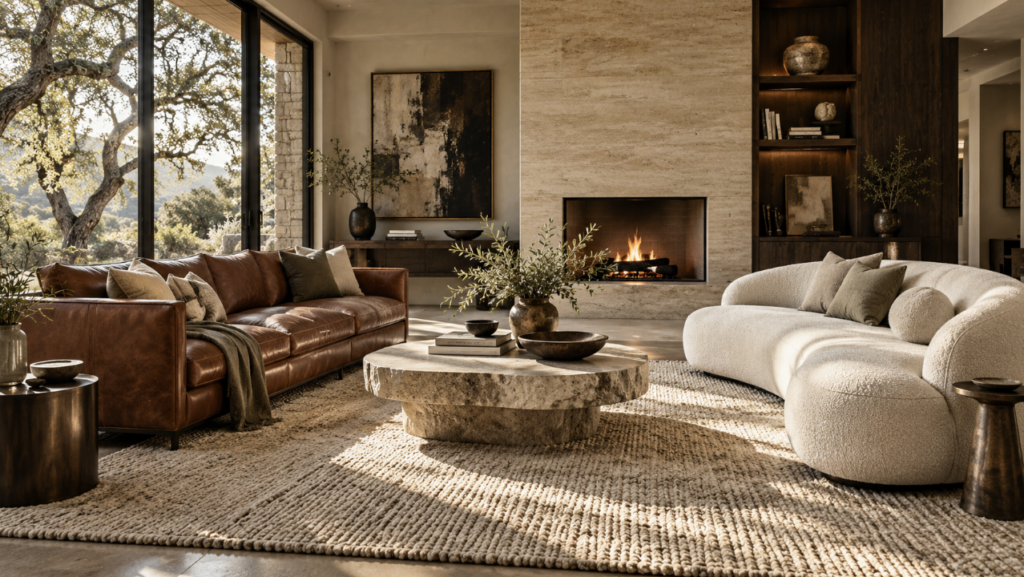
Photographs and construction illustration: American Leather, Omnia Leather, and Vilmers, respectively. All manufacturer image rights remain with their owners. Header: AI-generated editorial concept illustrating two design directions; it does not depict identified brand models or establish their origin.
Comments are closed here.