By Leather Leather Furniture Gallery | Menlo Park California
Leather began as a practical way to make use of animal hides. Over thousands of years, the skills used to preserve and soften those hides developed into the leather we now use for sofas, recliners, dining chairs, headboards and architectural upholstery. Its appeal still combines usefulness with beauty: a well chosen leather can be comfortable, durable, repairable and full of character.
But leather is a family of materials, not one uniform product. The hide, tanning method, surface finish and furniture construction all affect how a piece will perform. Understanding those differences makes it easier to choose leather for children, pets, busy living rooms or a quieter space where natural patina is part of the attraction.
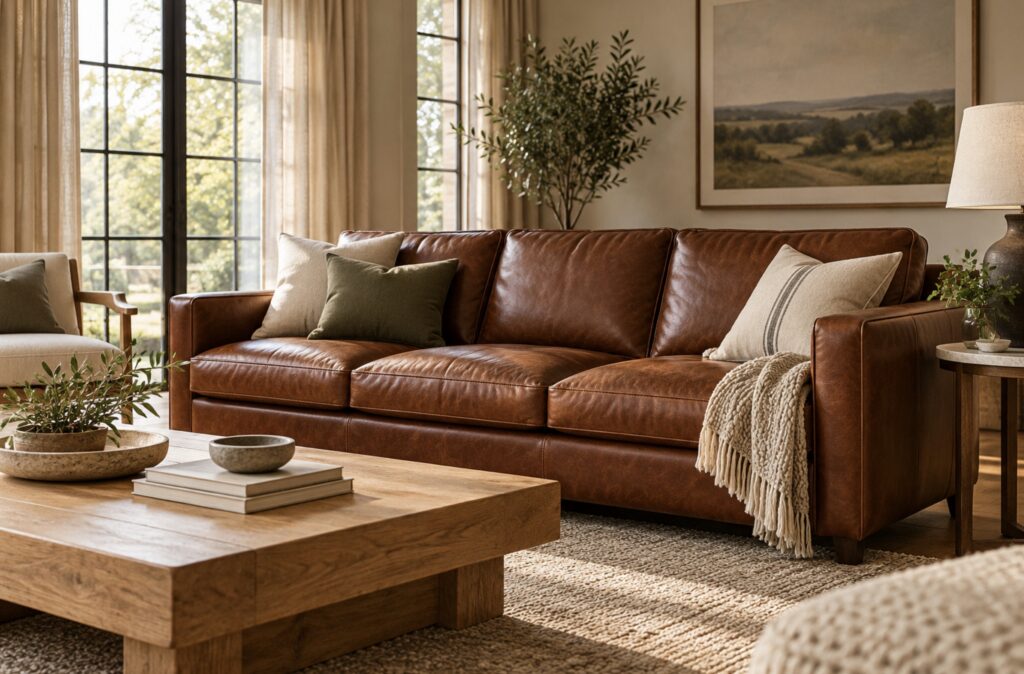
Leather brings warmth and texture to a tailored living room.
From early hides to modern furniture
Long before modern textiles, people used animal skins for clothing, shelter and everyday equipment. Untreated hides could stiffen or deteriorate; preservation and tanning techniques made them more useful. Leatherworking traditions developed across many cultures rather than beginning with a single inventor or one documented first use.
Plant tannins became an important way to preserve hides. Craftspeople also developed methods involving fats, oils, smoke and mineral compounds. Over time, leather served footwear, saddlery, containers, bookbinding, furniture and interior decoration. Cortina Leathers describes improvements in medieval Spain that expanded the softness and color possibilities of leather for upholstery and decoration. [1]
Some early leather seating used thick leather panels attached directly to wooden frames, without the padding we associate with upholstery today. A Victoria and Albert Museum collection record describes this construction in chairs of the Hispanic world from the seventeenth century. Later furniture combined leather with cushioning, springs and more elaborate upholstery techniques. [2]
The late nineteenth century introduction of chromium salt tanning helped make softer, thinner leathers widely available for applications including upholstery. Today, computer assisted cutting, controlled dyeing and specialized finishing coexist with the craft of selecting hides and tailoring them around a frame. Modern leather can look rustic, smooth, matte, velvety, softly aged or highly uniform. [3]
Where upholstery leather comes from
Much furniture leather is bovine leather, meaning cattle hide. Large hides are useful for seat cushions, sofa backs and broad upholstery panels. Buffalo and other animal leathers also appear in selected collections; the animal species should be identified in the supplier specification.
Conventional bovine leather uses hides associated with meat production. Turning that material into a long lived product can recover value from a resource that already exists. That does not erase the environmental effects of livestock farming or make leather impact free. Responsible sourcing must consider the animal supply chain as well as what happens inside the tannery. [4]
Natural hides vary across their surface. Neck wrinkles, healed scars, grain variation and changes in texture can remain visible, depending on selection and finishing. These characteristics differ from open damage or a manufacturing fault. A useful showroom conversation includes which markings are acceptable for the leather you choose.
How many tanneries are there around the world
There is no single verified, current worldwide census that we can responsibly quote as an exact total. Counts differ depending on whether they include small workshops, complete tanneries, finishing facilities, subcontractors and traders.
For a documented indication of scale, Leather Working Group reported 2,316 certified suppliers in its 2025 review, with a presence in more than 60 countries. That is the organization’s supplier network, not a count of every tannery worldwide. Its directory also distinguishes site types, so certified suppliers should not all be described as complete tanneries. [5]
For a furniture buyer, the more useful question is whether the leather’s tannery and environmental performance can be documented. A country name or an expensive sofa alone does not answer that question.
Hide selection and cutting help determine the final upholstery result.
How a hide becomes upholstery leather
The process varies by tannery and product, but the main stages follow a recognizable sequence. [6]
Preservation and preparation come first. Hides are preserved for transport, then cleaned and prepared. Unwanted tissue and, for ordinary smooth upholstery leather, hair are removed. Controlled processing prepares the collagen structure for tanning.
Tanning stabilizes the hide so it resists decomposition and becomes usable leather. Tanneries choose vegetable, chromium based, alternative or combined systems according to the properties needed.
Splitting and thickness control help create a material suited to its purpose. A hide can be separated into a grain bearing upper layer and lower split layers. Shaving helps control thickness; upholstery leather needs to work with seams, curves and cushioning.
Retanning, dyeing and softening develop the desired body, color and flexibility. Fatliquoring introduces lubricating agents that help fibers move without becoming stiff. Dyeing introduces color; it is a different operation from tanning. [7]
Drying, milling and finishing establish the final feel and appearance. Tumbling can soften leather and bring out its texture. Finishes can add color consistency, protection, sheen or special effects. Furniture makers then inspect and cut the leather, matching panels and tailoring seams to the design.
Vegetable tanning is different from vegetable dyeing
Vegetable tanned leather is leather stabilized using plant tannins, such as extracts from bark, wood, leaves or fruits. The word vegetable describes the tanning agents; it does not mean the leather is plant based or animal free. Vegetable tanning can produce rich character and attractive aging, though the familiar firm leather used for belts is not representative of every vegetable tanned product. [8]
Vegetable dyed leather is a separate claim about the source of the colorant. A vegetable tanned hide may be colored using other dyes, and a plant derived dye does not tell you how the hide was tanned. When a supplier uses either phrase, ask which process it describes.
Chrome tanned leather uses chromium salts and is widely used where softness and flexibility are important. Chrome free leather uses other tanning systems. Metal free and chrome free are not interchangeable descriptions, and neither means chemical free. Combination tanning or retanning uses more than one approach to develop particular properties. [9]
Can leather be an environmentally thoughtful choice
Screenshot
Leather’s strongest environmental argument is a useful product kept in service. A sofa that continues to suit its owner, can be maintained and can be repaired may avoid repeated replacement. That advantage depends on the entire piece: the frame, suspension, cushioning, leather, care and actual years of use.
Recovering hides, reducing waste and extending furniture life are meaningful benefits. They support a qualified description such as responsibly sourced, long lasting leather rather than a blanket claim that every leather is eco friendly. [4]
Tanning still requires water, energy and chemicals, and its wastewater needs proper treatment. Vegetable tanning is not automatically the lowest impact option: plant extraction, processing time, chemical inputs and effluent also matter. The responsible comparison is between specific production systems and products, not simply natural versus synthetic tanning agents. [9]
Leather Working Group audits address areas such as environmental management, water, energy and chemical management. Ask for evidence tied to the relevant supplying facility rather than assuming every leather from a brand has the same certification. Such evidence is useful, but it does not establish that a finished sofa has no environmental impact. [10]
Avoid assuming that a finished leather sofa is compostable or readily recyclable. Coatings, adhesives, foam and mixed construction complicate its end of life. Continued use, appropriate repair and reupholstery are often more practical questions to explore first.
Screenshot
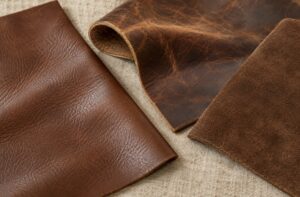
Grain, color movement and nap create very different surface effects.
Understanding leather names
Leather descriptions answer different questions. Full grain describes the hide surface; aniline describes the coloring and finish; pull up describes an effect. One leather can belong to several categories at once. These are overlapping descriptions, not a single ladder from good to bad.
Full grain and top grain
Full grain retains the natural grain surface without sanding away that grain. It can show wrinkles, pores and other natural variation. A full grain leather can receive different finishes, so full grain does not automatically mean unprotected. [11]
Top grain generally identifies leather from the grain bearing upper portion of the hide. Furniture terminology varies: some suppliers use it broadly, while others use it to distinguish a corrected surface from full grain. Ask whether the natural grain has been sanded or embossed rather than relying on the phrase alone.
Corrected grain has been mechanically altered, often by buffing, and may receive an embossed pattern and protective finish. Enhanced grain describes grain given additional definition. An embossed surface can still be real leather; the pattern alone does not establish authenticity. [12]
Split leather comes from a lower layer after separation from the grain bearing layer. It can become suede or receive a coating. Its suitability depends on the product and application; a coated split should not be represented as equivalent to intact full grain leather. [13]
Pure aniline and full aniline
These names commonly describe leather colored with transparent dyes, without an opaque pigment layer hiding the natural surface. They emphasize depth of color, a soft hand and individual markings. Exact protective treatments vary, so ask for the specific finish description.
Aniline leather is attractive when natural variation and patina are priorities. It is usually more vulnerable to absorbed spills, body oils and changes from light than a strongly protected leather. Pure or full refers to this finish description, not to thickness or a promise of maximum stain resistance. [14]
Semi aniline
Semi aniline combines dyeing with a light pigmented or protective finish, retaining some natural character while improving consistency and practicality. It is not half real leather. For many buyers it offers a useful middle ground, but protection levels vary by collection. [15]
Pigmented and protected leather
Pigmented leather has a surface color layer and usually a protective topcoat. It often provides more uniform color and easier everyday maintenance. This can make it a strong candidate for frequently used family seating. A protected surface is still subject to wear, punctures and damage; protected does not mean indestructible. [16]
Wax pull up and oil pull up
Pull up is the lighter color effect that appears when certain leathers are stretched or bent, as oils and waxes move within the leather or its finish. This creates tonal depth around seams, arms and tufting.
Wax pull up emphasizes wax treatments; oil pull up emphasizes oils. Some leathers use both. The exact recipe determines whether the surface feels dry, waxy or softly oily, and how much color movement appears. Pull up is not a separate animal species or a guarantee of a particular tanning method. [17]
These leathers often appeal to people who welcome evolving character. Some light surface marks may blend with approved care, but a cut or puncture does not heal. Never demonstrate pull up by scratching showroom furniture; examine a sample with permission.
Nubuck and suede
Nubuck has its grain side lightly abraded to create a fine, velvety nap. Suede has a napped surface made from the flesh side or a split. Both are real leather when made from animal hide, though similarly textured synthetic products also exist.
Their softness can be appealing, but spills, oils and nap changes may be more visible. They need care products specifically suited to their surface and are worth discussing carefully for a busy sofa. [18]
Other terms you may encounter
Nappa or napa generally suggests soft, supple leather, rather than a universal performance grade. Milled leather has been mechanically tumbled to soften it and develop texture. Distressed and antiqued describe an intentionally aged or varied appearance. Two tone and sauvage describe color effects; patent describes a glossy finish. Hair on hide retains the hair rather than presenting a smooth leather surface. [19]
Upholstery leather is prepared for furniture use, while tooling, saddle and garment leathers are made for other requirements. A beautiful hide is not automatically appropriate for seating. Ask about thickness, stretch, flexibility, finish performance and the furniture maker’s approval.
Genuine leather is a broad authenticity description, not a dependable quality grade. Pricing grades such as A, B or D are generally specific to a manufacturer and cannot be compared across brands as a universal durability scale.
Bonded or reconstituted leather combines leather fibers or particles with binders and other materials. Bicast commonly describes split leather with a polyurethane surface. Neither should be confused with an intact full grain hide, and a smooth coated surface can obscure the material beneath it. [13]
Choose a finish that suits the people and pets who use your furniture.
Why leather can work well for families and pets
The practical question is how a particular leather will handle your household. American Leather, for example, distinguishes light, medium and heavy protection and specifically identifies its heavy protection options as suitable for children and pets. That is more useful information than simply choosing the highest price grade. [20]
For a household with frequent spills, ask about a pigmented leather or a well protected semi aniline. For someone who values natural shading and accepts visible change, aniline or pull up may be appealing. For a quiet reading chair, nubuck may deserve consideration even if you would choose something more protected for the family sectional.
Smooth leather makes loose pet hair easier to remove than a surface where it becomes embedded, but it is not claw proof. Trim nails, discourage scratching and consider a washable throw in a pet’s favorite spot. A cat that actively scratches furniture can damage any leather. Dog claws, grit and repeated jumping can also leave marks.
Ask to see a large sample and discuss your actual routine: children with drinks, a dog that sleeps on the cushions, sunny windows or an owner who wants very little visible change. A dark or varied color may disguise some marks, but it cannot substitute for the right finish.
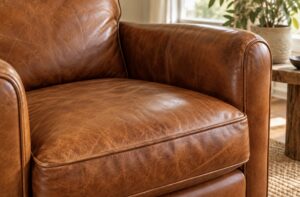
Gentle creasing and burnishing can become part of leather’s character.
Does leather become more durable with age
Leather can soften and develop patina: changes in sheen, color and surface character from handling and use. On a suitable leather, gentle creases and burnishing can make a piece increasingly individual. Moore and Giles describes this evolution as a central attraction of natural leather. [21]
That visual improvement is different from increasing physical strength. Use does not make leather immune to abrasion or drying. Cracking, torn seams, peeling finishes and punctures are damage, not simply desirable patina. A relaxed cushion can also reflect foam or suspension changes rather than a leather problem.
Choosing well means deciding which changes you will enjoy and which you would find frustrating.
Edges and backing provide clues, while written specifications establish composition.
How to identify faux leather without damaging it
Start with documentation. Ask for the composition, the animal species where relevant, the leather type and which areas of the furniture use it. Leather match often means leather on selected contact areas with a matching synthetic material elsewhere. Confirm the seat, inside back, arms, outside back and sides individually.
Faux leather may be described as polyurethane or PU, vinyl or PVC, synthetic leather, leatherette or vegan leather. Vegan describes the absence of animal derived material; it does not establish that a product is plastic free, biodegradable or environmentally preferable. Plant based alternatives can contain synthetic binders and coatings, so request the full composition. [22]
With permission, inspect a loose sample’s edge and reverse. Leather commonly shows a fibrous cross section; many imitations show a coating over a textile backing. A backing is a clue rather than proof because real leather can also be reinforced or laminated.
Look at surface variation, but do not use it as a verdict. Repeated patterns can suggest embossing, yet genuine leather is also embossed. Modern faux materials can feel convincing, while heavily finished leather can feel uniform. Smell, softness and price are not reliable stand alone tests.
Do not burn, scratch, puncture or apply solvents to furniture to test authenticity. Water absorption is also inconclusive: protected real leather may repel water, while absorbent materials can stain. If a material remains uncertain, a qualified leather specialist or laboratory can examine a detached sample. The safest purchase evidence is a clear written specification.
Caring for leather so it stays useful
Follow the furniture and leather supplier’s instructions first. Different finishes need different care. Remove dust and grit gently, blot spills promptly and avoid scrubbing. Keep furniture away from excessive heat and manage direct sunlight. Test any approved product on an inconspicuous area before wider use. [23]
Use only products suitable for the exact leather. A general conditioner may darken aniline or alter nubuck; ordinary household cleaners, alcohol products, oils and improvised recipes can damage finishes. More product is not necessarily better care.
If a piece needs attention, ask what can realistically be improved. Depending on its condition and finish, professional cleaning, color restoration, repairs, cushion work or reupholstery may extend its usefulness. Restoration cannot guarantee removal of every stain or restoration of lost strength.
Choosing leather at Leather Leather Furniture Gallery
At Leather Leather Furniture Gallery in Menlo Park, we help connect the look you want with how you live. A natural aniline, a richly shaded pull up and a protected family leather each offer something different. Comparing samples in person helps reveal softness, sheen, texture and the changes to expect over time.
We offer custom furniture along with reupholstery, leather restoration and repair services. Whether you are choosing a new sofa or evaluating a piece you already own, the goal is a leather and construction suited to years of comfortable use.
Visit Leather Leather Furniture Gallery in Menlo Park or call 650 617 0220 to discuss your project.
Sources
[1] Cortina Leathers — History of Leather https://www.cortinaleathers.com/resources/history-of-leather/
[2] Victoria and Albert Museum collection record via Museum Data Service https://museumdata.uk/object-search/object/?pid=cedbbe31-339c-3844-8213-6dbafcad4586
[3] ILO Encyclopaedia — Leather Fur and Footwear https://iloencyclopaedia.org/contents/part-xiv-42166/leather-fur-and-footwear
[4] Leather Naturally — Frequently Asked Questions https://www.leathernaturally.org/faqs/
[5] Leather Working Group — 2025 Year in Review and supplier directory https://www.leatherworkinggroup.com/news-events/the-leather-working-group-2025-year-in-review-is-here/ https://www.leatherworkinggroup.com/get-involved/our-community/certified-suppliers/
[6] Leather Naturally — Back to Basics Leather Manufacture https://www.leathernaturally.org/wp-content/uploads/2023/03/B-to-B_English.pdf
[7] American Leather — How Leather Is Made https://www.americanleather.com/resource-center/how-leather-is-made/
[8] Leather Naturally — FAQs on vegetable tanning https://www.leathernaturally.org/faqs/
[9] Leather Naturally — Different Types of Tanning https://www.leathertruthfully.com/Education/Fact-Sheets/Manufacturing/Summary-of-the-different-types-of-tanning
[10] Leather Working Group — FAQs https://www.leatherworkinggroup.com/learn-more/faqs/
[11] Spinneybeck — About Leather https://www.spinneybeck.com/leather
[12] Spinneybeck — Types of Leather https://www.spinneybeck.com/images/uploads/downloads/SB_Types_of_Leather.pdf
[13] Leather Naturally — Leather Terminology https://www.leathernaturally.org/wp-content/uploads/2023/02/LN_FactSheet_Guide_Leather_Terminology.pdf
[14] Altfield — About Leather https://www.altfield.com/technical-information/about-leather/
[15] Moore and Giles — Glossary https://mooreandgilesleather.com/glossary/
[16] Cortina Leathers — Leather Types https://www.cortinaleathers.com/resources/leather-types/
[17] Garrett Leather — Glossary https://garrettleather.com/resources/glossary.html
[18] Leather Naturally — Getting the Most Out of Leather https://www.leathernaturally.org/wp-content/uploads/2023/05/LN_Fact_Sheet_Guide_How-to-care-for-Leather.pdf
[19] German Leather Federation — Leather A to Z https://vdl-web.de/en/leather/leather-a-z/
[20] American Leather — Leather Fabrics https://www.americanleather.com/leather-fabrics/
[21] Moore and Giles — Natural Leather 101 https://mooreandgiles.com/natural-leather-101
[22] Leather Naturally — Leather and Alternatives https://www.leathernaturally.org/wp-content/uploads/2023/02/LN_FactSheet_Guide_Leather_-_Leather_Alternatives.pdf
[23] Guardsman — Leather Types https://www.guardsman.com/leathertypes/
 The process varies by tannery and product, but the main stages follow a recognizable sequence. [6]
Preservation and preparation come first. Hides are preserved for transport, then cleaned and prepared. Unwanted tissue and, for ordinary smooth upholstery leather, hair are removed. Controlled processing prepares the collagen structure for tanning.
Tanning stabilizes the hide so it resists decomposition and becomes usable leather. Tanneries choose vegetable, chromium based, alternative or combined systems according to the properties needed.
Splitting and thickness control help create a material suited to its purpose. A hide can be separated into a grain bearing upper layer and lower split layers. Shaving helps control thickness; upholstery leather needs to work with seams, curves and cushioning.
Retanning, dyeing and softening develop the desired body, color and flexibility. Fatliquoring introduces lubricating agents that help fibers move without becoming stiff. Dyeing introduces color; it is a different operation from tanning. [7]
Drying, milling and finishing establish the final feel and appearance. Tumbling can soften leather and bring out its texture. Finishes can add color consistency, protection, sheen or special effects. Furniture makers then inspect and cut the leather, matching panels and tailoring seams to the design.

Comments are closed here.